

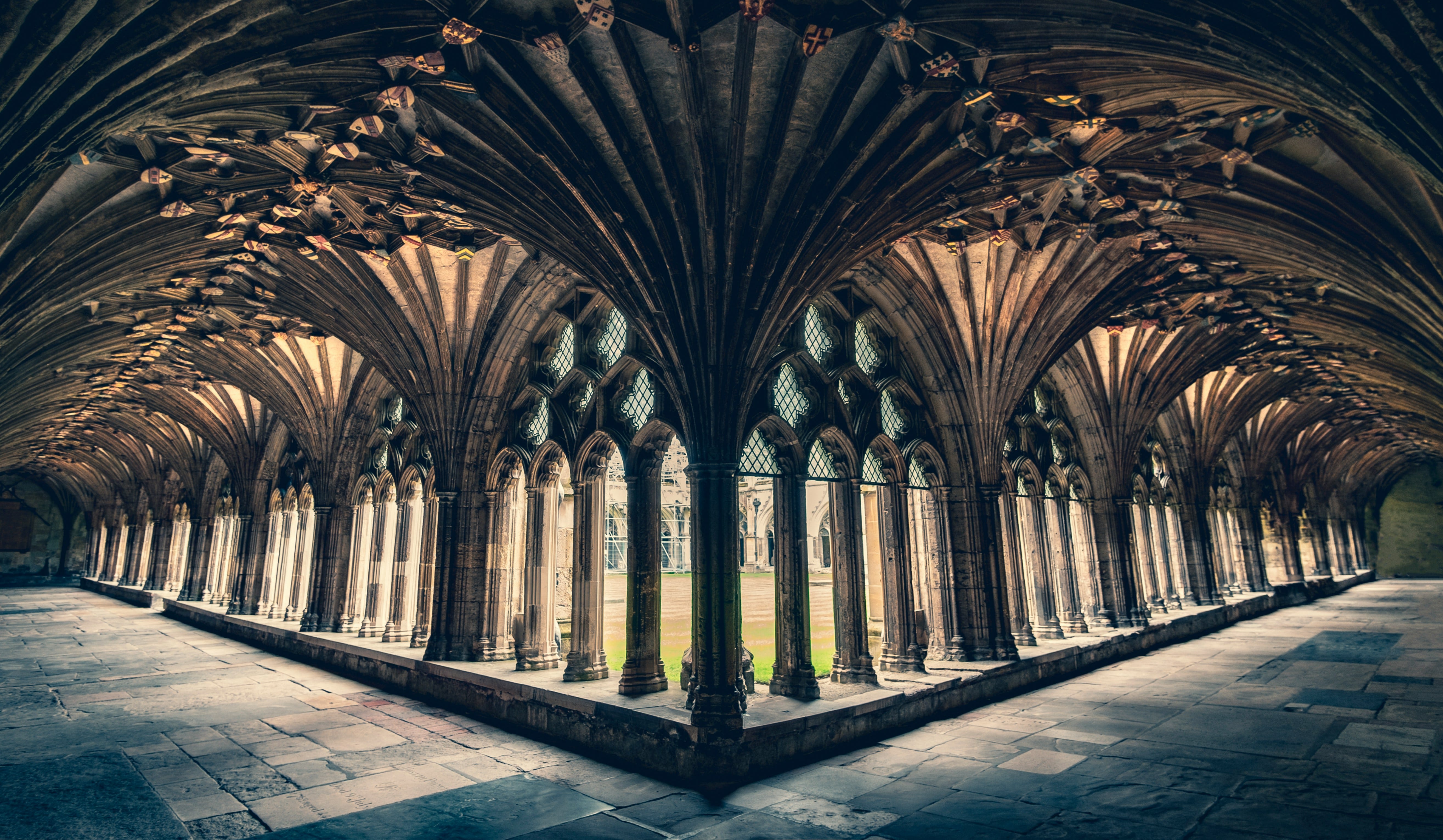
Despite being a creature whose natural habitat is a library, I did not read my way into the Anglican Communion. It all started a bit more organically than that. A stumbling into an Episcopal Church in Lancaster, PA, while on vacation. A realization that the beautiful stone church we drove past constantly was, in fact, also Episcopalian. Popping into that congregation on a Sunday we weren’t serving at our old church to see if the liturgy from vacation was just a one-off fluke, diamond in the rough. Being delighted that wasn’t the case. Progressively falling in love with it. The people. The liturgy. The preaching. The elderly couple whose faces break out in ear-to-ear grins every time we sit in the pew behind them. The coffee hour stories. even the ones you’ve heard before. Maybe especially those. Eventually the BCP takes up permanent residence on the kitchen table. Before you know it, you’re on the vestry. That type of thing.
Overall, I’m quite grateful that this was the path we took into the Church. I pretty much talk about books for a living, and it’s a constant temptation to live the entirety of my life between my ears. But this caught our hearts and bodies before our head. When it did catch my head, it was more so a realization that I had inadvertently adopted a way of thinking about theology that was amenable to a stream of Anglicanism than any sort of intentional catechesis at the hands of Anglicans.
Most of my theological reading is spent with the Fathers, Russian Silver Age thinkers, and 20th century Catholic Ressourcement theologians. Perhaps in a Rowan Williams-esque fashion, these seem to me to be perfectly good teachers for an Anglican.
Nevertheless, I’ve recently been trying to fill in the lacuna of explicitly Anglican influences in my theological study. So, in today’s post, I thought I’d continue my Notes from an Armchair Theologian series in which I give a brief rundown of some books that I’ve been reading. My goal with this is really two-fold. First, I hope it’s helpful for others who are seeking good books to read by Anglican writers. Second, and much more selfishly, I hope some Anglicans further along the Canterbury Trail might chime in with recommendations on where to go next.
Anglican Identities by Rowan Williams
This small book is a collection of essays from the former Archbishop of Canterbury on various influential Anglicans throughout history. It is not the first book I’ve read by Williams, but it is the one most geared toward this particular project of Anglicanization. And, honestly, it’s a pretty perfect fit. Because it surveys such a wide variety of theologians, ranging from Tyndale (whom Williams cheekily includes as an Anglican) up to John A. T. Robinson, it is a difficult book to summarize. However, what I’ll briefly note is that Williams does a remarkable job of not highlighting one stream of Anglican thought as the only true one and considering any departures from that a fall from grace. While he doesn’t flatten them all into a false equality of value, he does show the promises and pitfall that each holds within their systems of thought and constantly strives toward creative synthesis and further improvement.
Frequent readers will know I hold Williams in the highest esteem, and getting to see his perspective on some of the major characters in the Anglican story has been a perfect launchpad for further study. In fact, it was this book which prompted me to read the next book on this list:
The Christian Priest Today by Michael Ramsey
From one former Archbishop of Canterbury to another, this list is also going from strength to strength. While Williams’s book is more academic, Ramsey’s is profoundly pastoral. Though it is directed toward ordinands, the wisdom found herein is profoundly applicable to people of all vocations. It is a book so rich that I’ve had to force myself to read it slowly and savor it, otherwise I’ll simply have to immediately begin to re-read it. Honestly, it’s that good.
I have so many passages underlined in this book that it’s hard to pick one or two to give you a taste of what one finds in this short work. For instance:
The glory of Christianity is its claim that small things really matter and that the small company, the very few, the one man, the one woman, the one child are of infinite worth to God. … For the infinite worth of the one is the key to the Christian understanding of the many.1
It’s not all soaring rhetoric though about the glory of the Gospel. You’ll also get down-to-earth wisdom like this, on the role of humor in humility:
Use your sense of humour. Laugh about things, laugh at the absurdities of life, laugh about yourself, and about your own absurdity. We are all of us infinitesimally small and ludicrous creatures within God’s universe. You have to be serious, but never be solemn, because if you are solemn about anything there is a risk of becoming solemn about yourself.2
The Purple Headed Mountain by Martin Thornton
Not too long ago, I had the pleasure of interview Fr Matthew C. Dallman about the Anglican spiritual tradition, and he not only introduced me to the work of Martin Thornton, but he was kind enough to send me a few of his books. Unlike our last two authors, Thornton was not an Archbishop of Canterbury (though, admittedly, the genealogy continues insofar as Ramsey wrote the original forward for this book). He was a 20th century farmer and priest in the Church of England who had a remarkable knack for combining orthodox, historical theology with the practical spiritual needs of everyday people.
Something I’ve learned along the way from people wiser than me, is that the path to excellence in most spheres of life is actually fairly simple. It may not be easy, but it is often simple. For instance, I recall once asking a man who was remarkably strong and fit well into his 70’s what his secret was. His answer? “I just keep walking through the doors of the gym.” Thornton teaches us that, in many ways, the spiritual life is like this. We want the secret to spiritual growth to be complicated because then our lack of growth is due to us not figuring out the magic formula. If we just find that one new devotion, then things will change. Kind of like how we’ll spend hours, weeks, or even months, looking at different exercise plans from the comfort of our couch when, in reality, the most basic of plans consistently applied will yield results in time.
For Thornton, that basic plan is the reception of the Eucharist, praying the Office, and private devotion according to personal needs and abilities. No need to complicate things. Just do it. Very Long Obedience in the Same Direction type of feel for those familiar with Eugene Peterson. As someone who has jumped between devotional practices and dumped many after a month seeking something better, I can attest that the stability of simply praying the Office for the past two years has been much preferable.
King Oswald’s Heirs by Thomas Plant
“Re-enchantment” has been a bit of a buzzword for the last decade or so, and this past year has been something of a high water mark between Martin Shaw’s Liturgies of the Wild and Paul Kingsnorth’s Against the Machine. The basic impulse seems to be a sense that modernity/post-modernity has lost something of the God-filled, meaning-saturated view of the world that our ancestors had, and this is showing up in a wide variety of ways, most of which have some connection to our discontentment and despair. As is often the case, diagnosis and is easier than prescription. One source of re-enchantment that probably isn’t high on most people’s list—indeed, I would be surprised if it was anywhere on the list—is the catechism of the 1662 Book of Common Prayer.
But that’s exactly where Fr Thomas Plant SSC looks for inspiration in his eminently readable book, King Oswald’s Heirs. Like Fr. Dallman, I met Fr. Thomas through the work I do online. Initially, I was interested in his work on Ps. Dionysius and Christian Platonism, but soon after our first conversation, he announced his next book, and I was immediately drawn in by the notion of a Reformation-era catechism being a source of re-enchantment. Plant connects things as simple as the catechism’s question of “what is your name?” with the struggles the modern world has with identity, and he argues for a sense of rootedness in place and tradition that is a challenge to our default ways of looking at things. As I mentioned earlier, I’m a big fan of the ressourcement theologians, and this book offers a picture of what it’s like to do a sort of creative Anglican ressourcement project, mining the tradition for answers to the present.
The Complete Poetry by George Herbert
Truthfully, I started reading this long before I even became Anglican, but I’ve tried to incorporate a poem a day of late. If I tried to adequately express my appreciation for Herbert, I would fill an entire post and still have only sullied his poetry with my lackluster prose. Suffice it to say, he’s great. Read him. You won’t regret it.
Walk in Love by Melody Wilson Shobe and Scott Gunn
I’ll end this list where my Anglican—or in this case, specifically Episcopalian—reading began: Walk in Love. This book comes from Forward Movement, an Episcopalian organization dedicated to inspiring discipleship and growth within TEC. It’s very much a “Beginner’s Guide to the Episcopal Church” type of book, and my wife and I took to reading it together at dinner over Lent. It’s eminently accessible, and its frequent connection to the Prayer Book is a particularly welcome feature.
Though it is certainly theological in nature, it is more of a survey than a deep dive as it covers a vast range of topics. Its chief merit is its accessibility. The chapters are short in pages and even shorter on jargon. It’s the kind of book I wouldn’t hesitate to give to someone who said, “I’m brand new to all of this, can you tell me what Episcopalians are about?” And for a church that is sometimes, to a fault, a church for people who already like church, this is a great accomplishment.
Honorable Mention: The Average Episcopalian
On the point of accessibility, I really ought to add the podcast, “The Average Episcopalian.” It is no small delight that my wife is constantly telling me what she’s learned from this podcast and how much she adores it. The two sisters who host the podcast have a genuine and infectious love for the church, and I suspect this enthusiasm feeds into Eliza’s almost daily statements of “I just love the Episcopal Church!”
So enjoyable is that to see and hear that I even count it a joy when she tells me that this podcast makes a lot more sense and is generally just more enjoyable than my nerdy YouTube videos.3
Honestly, I get it.
Where to Next?
So much for the books I’ve been reading specifically for this project of Anglicanization. I have, of course, read other books by Anglican authors over the course of time, but those haven’t been for this specific purpose. From here, I have a few books on the horizon, but I would love to hear recommendations from my Anglican friends out there. Here are a few I have on my list:
Laws of Ecclesiastical Polity by Richard Hooker: If for no other reason than being able to feel like a real Anglican for having read it (or parts of it, let’s not get too ambitious).
A History of the Episcopal Church by Robert Pritchard: Confession: I began this book but didn’t finish it. I really should. I’ll try.
Absolutely anything by Rowan Williams that I haven’t yet read.
The Gospel and the Catholic Church by Michael Ramsey: I so thoroughly enjoyed The Christian Priest Today and this seems the best book by him to read next.
Tracts for Our Times: I’ve read a good deal of Newman and some of Pusey in other works, but I’m too fond of the Anglo-Catholic stream to have not read the Tracts. Shameful, I know.
Christian Dogma by Darwell Stone: Fr. Thomas Plant recommended this but I just haven’t gotten to it yet.
Christ, The Christian, and The Church by E. L. Mascall: See my comments on Anglo-Catholic shame.
The Spiritual Life by Evelyn Underhill: I hope by now you all are realizing that I’m not a real Anglican and you should never invite me to your parties.
Praying Shapes Believing by Leonel L. Mitchell: Okay, this one I just got in the mail so can I get a pass on not having read it yet?
That is, admittedly, quite a long reading list already, and I have no idea how long it will take me to get through those as most of my reading time is taken up with reading for YouTube videos and I’m currently in the midst of a long series on the history of Marian devotion. Although, I suppose I could turn any number of these into future videos outside that series. You know, kill feed two birds, with one stone scone.
Anyway, Anglican friends, if I haven’t spurned all your goodwill by revealing how shamefully under-read I am, I would appreciate your recommendations.
Michael Ramsey, The Christian Priest Today (London: SPCK, 2009), 42.
Michael Ramsey, The Christian Priest Today, 81.
Eliza is a very kind and supportive wife who says these things with a smile and a “I love that you love that and that some people who aren’t me love that” type of enthusiasm.
We fear that, in response to being mentioned in the same list as Rowan Williams, our "Average" license might soon be revoked. Thank you for the kind words and ongoing support of both you and your wife !!
Not an Anglican, but I did love JRH Moorman's "A History of the Church in England." I'm not sure how it stacks against other church history books on the same topic, but I devoured it fairly quickly and loved it.