
Humanism and Fundamentalism
A Tale of Two College Experiences

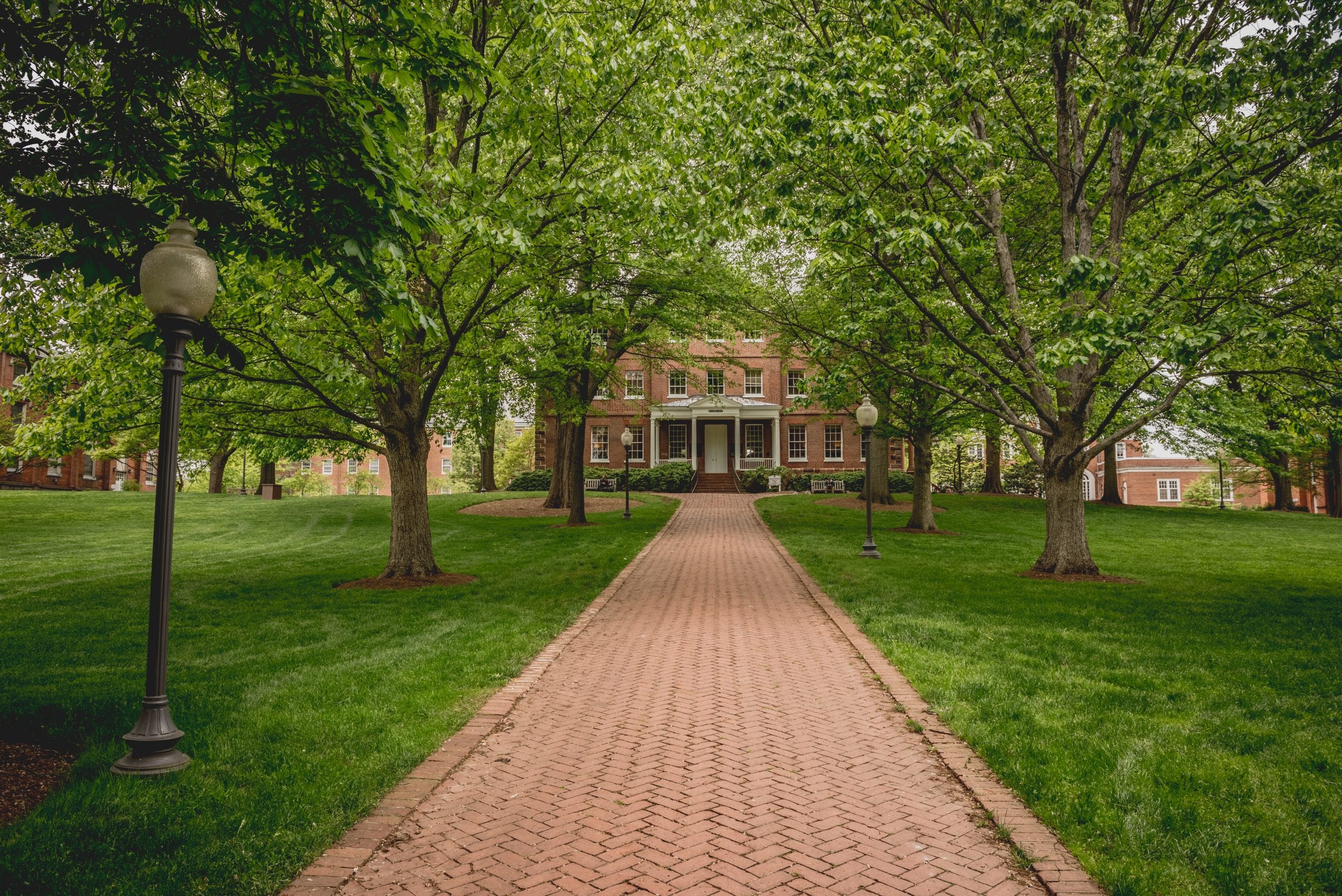
It’s the beginning of the end.
No, not of the world. At least, I don’t think so. It’s the beginning of the end of my time at St. John’s College where I will soon—Lord willing—receive a Master’s in Liberal Arts. Today, is the first day of my last semester before writing my master’s essay to conclude my degree.
As the end draws near, I’m struck by just how different my two college experiences have been. Of course, there are similarities, studying Theology at Moody Bible Institute and studying Liberal Arts at St. John’s. Both meant a steady diet of reading old books and writing long papers. Aquinas and Augustine appeared in both, I’ve made great friends at each institution, and, importantly, I’ve thoroughly enjoyed my time pursuing these degrees.
Which is good, considering their economic benefit is slim to none.
However, the differences have been striking. As I’ve reflected on them, I’ve come to think that, above all, it’s a difference between Humanism and Fundamentalism.
Let’s begin with Moody.
Moody Bible Institute: Fundamentalism
When I was 18, I stumbled across the work of New Testament scholar NT Wright. I’d always been the bookish type, but my passion for academics had been focused on literature. I was the weird high school student who once brought a copy of Aristotle’s Poetics with me to the beach for some summer reading. Faith, on the other hand, while a big part of my life, was something personal and devotional, but not academic. Thanks to Wright, though, I became aware of the fact that my love for parsing poems or examining great literature could translate into the realm of faith.
I was hooked.
At the time, I was taking a gap year, working full-time at a church doing social media for them. I decided I’d take some online theology classes to see what studying theology was like, and I stumbled across Moody’s online program. Honestly, I didn’t know much about the school, but I was told it was a place fully devoted to the study of the Bible. Sounded good to me.
It didn’t take long for me to realize that I enjoyed studying theology even more than I could have anticipated, and soon I was packing my bags to move to Chicago. If there was a chance of spending all my time doing this, and doing it in-person with other likeminded people, I wasn’t going to pass it up.
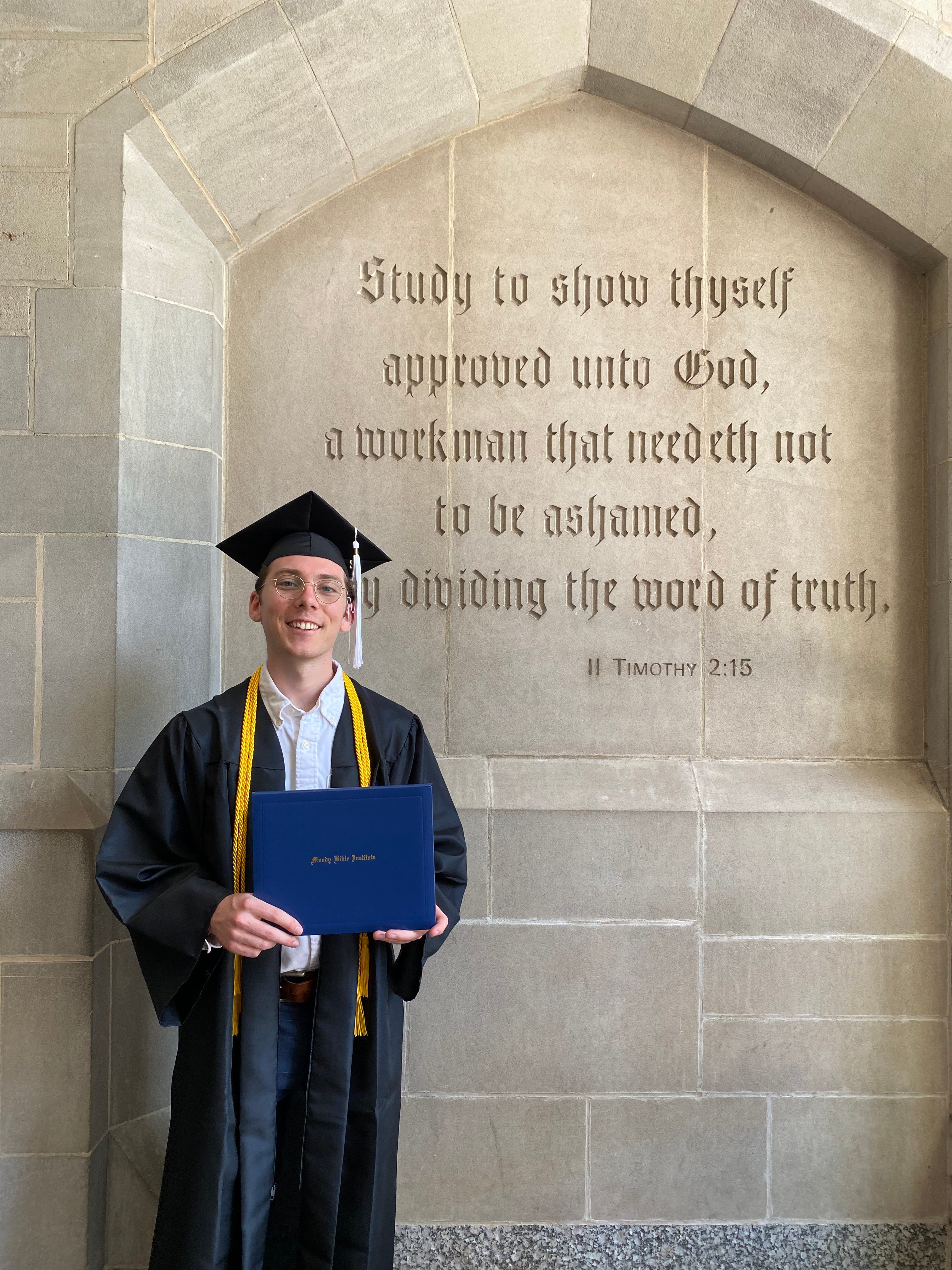
One of the first things you do when you apply to Moody is sign a doctrinal statement. This isn’t all that unusual for Bible colleges. Usually, you agree to some theological ideas in addition to a code of conduct.
The doctrinal portion of Moody’s agreement covered the following:
To be admitted and to graduate, students must personally adhere to and support the following doctrinal positions:
● The inspiration, authority, and inerrancy of Scripture
● The Trinity
● The full deity and full humanity of Christ
● The creation of humanity in the image of God
● The spiritual lostness of humanity
● The substitutionary atonement and bodily resurrection of Christ
● Salvation by grace through faith alone in Christ alone
● The physical and imminent return of Christ
● The eternal reward of the righteous and the eternal judgment of the lost
● In addition to the above doctrinal qualifications, all graduating students must personally adhere to and support the MBI position statement on biblical human sexuality
You might notice that you not only have to sign this to be admitted but also to graduate. In other words, on these 10 points, you cannot change your mind.
Therein we find a distinct pedagogical approach. The educational vision of a school like Moody is to select students with a certain set of beliefs and then form them into people who can, after a few years of study, articulate, defend, and live out those beliefs better than when they arrived.
Moody often describes itself as an undergraduate seminary, and they’re following in the footsteps of many traditional seminaries in this. A Lutheran seminary expects its students to be good Lutherans, a Catholic seminary expects its students to be good Catholics, so on and so forth.
And there’s something to be said for this. You know what you’re getting into when you sign up. This is not going to be a time for deconstruction. It’s a time for formation.
When you put it like that, it’s hard to argue. Furthermore, at least during my time at Moody, tuition was paid for by donors, so we were often told to remember that people weren’t paying for us to go wild and become heretics. They were paying to help build up the next generation of faithful Christian leaders.
Again, fair enough.
However, Moody is different from confessional seminaries in a number of ways. First of all, despite its language, the undergraduate college is an accredited undergraduate institution, not a seminary. It straddles two worlds then. On the one hand, there is the world of ministry formation, in which deepening a given identity makes a lot of sense. On the other hand, there is the world of the academy, which seeks to explore ideas with the possibility of coming to new conclusions.
Second, Moody isn’t attached to a denomination. And this is where the word fundamentalist might be appropriate, even if people at Moody might object. Coming up with 10 doctrinal positions, ranging from inerrancy to sola fide, risks seeming a bit arbitrary. After all, they’re not forming good Lutherans or good Catholics. They’re forming … well, I don’t know. Broadly conservative Evangelicals?
In other words, outside of a thick sense of traditional identity, Moody’s pedagogical approach can appear a bit ad hoc at best or stifling at worst.
On this account, the challenge with Moody’s fundamentalism is less the idea of committing students to a certain worldview and more a question of why that one? In many ways, I think this points to a larger breakdown of Evangelical identity in America. What does it mean to be an Evangelical in 21st century America? Is it holding those 10 positions?
St. John’s College: Humanism
After Moody, I made my way to St. John’s College following one year off academics. In many ways, it was the inverse of most academic progressions. I started with a fairly narrow degree in Theology which involved something like 90 credits in Bible and Theology and proceeded to a very broad degree in my graduate studies.
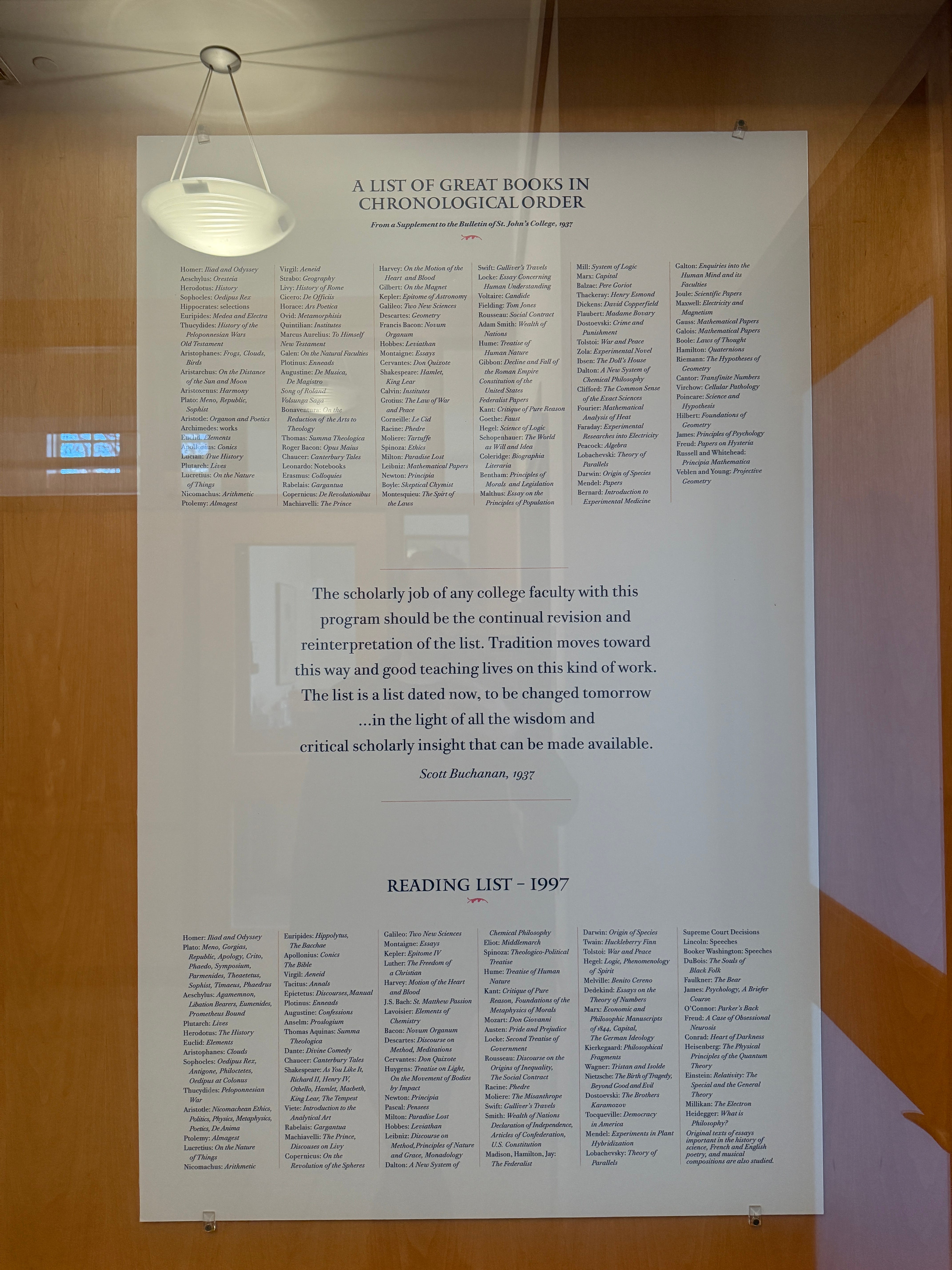
St. John’s is a unique school. The third oldest college in America, it prides itself on its Great Books curriculum. It offers one—and only one—undergraduate degree. All the students follow the same course of study, reading the greatest books of the Western tradition, spanning Homer to Heidegger, and covering five areas: Math and Natural Science, Philosophy and Theology, Literature, Politics and Society, and History. The graduate school is largely the same in structure, though slightly shorter in length, and there are the options of degrees in Liberal Arts, Eastern Classics, and Middle Eastern Classics.
Unlike nearly every college I know of, you won’t find professors lecturing at St. John’s. Instead, you’ll sit in circles around large wooden tables with only the text in front of you. No laptops, no secondary sources, no privileged point of view from the professor, just you, the text, your classmates, and tutors to guide the discussions. You’re graded on your contributions to the discussions, oral exams, and papers where you ask a question of the text and pursue it over many pages all on your own, no outside research.
All of these are distinct pedagogical choices. The tutors are not there to help you reach a conclusion. They’re there to model intellectual virtues and guide you into a deeper engagement with the Great Books.
I remember the first time I saw a tutor change their mind on something in the course of a seminar discussion. I couldn’t recall a single time I’d seen a professor do that in my undergraduate. They were the experts. We were the students. At St. John’s tutors—who are scholars in their own right—became conversation partners, people who wanted to learn alongside us and believed there was always more to learn from these texts, even if they’d been teaching them for 50 years.
It has been, without a doubt, the most intellectually stimulating experience of my life.
That is not to say I didn’t enjoy my time at Moody. I did greatly. In fact, I suspect it’s precisely what I needed at the time. But it is a distinctly different experience when you’re writing papers knowing that your professors have a right answer in mind versus writing papers when your tutors just want to see you think.
Is Theology a Liberal Art?
When evaluating these two models, much comes down to the importance you place on uniformity of conclusions. For many, theology must be confessional. The stakes are too high to allow it to be a matter of open enquiry. More mildly, some might say we can have open discussion on a number of topics—secondary and tertiary issues, for example—but, in the words of one of my Moody professors, “some questions are just off the table.”
It’s all fine and good to come to different conclusions on the meaning of glory in The Iliad, but can the liberal arts approach work in theology?
Within the theological world, I see four broad pedagogical options.
First, there is the Moody model, which essentially says, “there is one right answer to these primary questions, we have it, and it’s essential that our students begin and end with the same answer.”
Second, there is a pluralist confessional model, that says something like, “while there are a range of valid ways of looking at theology, here, at this school, our job is to train people in X tradition, so we expect our students to think likewise.” While similar to Moody, there’s a difference in that this model doesn’t claim to be the only valid approach, it’s simply the chosen approach for a given institution.
Third, there is the research university model. This model expects students to change their mind because the primary value of the university is constant progress. The views that students came in with should change to keep up to date with the latest research in the field.
Fourth, there is the humanistic, liberal arts model that says something like, “our goal is for our students to aim at Truth, and, trusting that Jesus is the Truth (or that Truth is simply good), we will allow them broad exploration.” Like the third model, it is comfortable with students changing their mind, but unlike the third model, it doesn’t assume that Truth is something toward which we constantly progress. In fact, it often assumes that finding Truth is a process of ressourcement, that we look backwards to make sense of the present and the Transcendental Truths that the Great Tradition has always attempted to reach.
Of course, this taxonomy of models is not perfect. There are overlaps between them, and, something that can be easy to miss is the interconnection of models two and four. While a school like St. John’s might feel very hands-off, there is of course the rigid commitment to the syllabus. The act of selecting the “Great Books” is a form of tradition. In this, one can see parallels to the canonization process in Christian theology, and even, to an extent, an ongoing magisterium, not in pronouncing authoritative interpretations, but in continuing to decide if the canon needs to expand or change.
As my time at St. John’s comes to a close, I’m only beginning to realize what an impact it has had on my own theology. Fittingly, that impact isn’t seen primarily in particular conclusions I’ve made from the texts I’ve read. Instead, that impact can be seen in my desired approach to theology.
I dream of a theology in which we can all sit with the Great Books of our tradition open in front of us—Scripture, the Fathers, etc.—and discuss these passionately with a continued openness to learning new things. It’s a vision of theology wherein ongoing communion is not grounded in shared conclusions, but a shared commitment to learning together. Where Tradition is less about unchanging dogmatic conclusions and more about entering into conversations with the people whom we’ve identified as having something to teach us.
And yet, the realist in me (which admittedly is a very small part of me), recognizes why the church hasn’t operated in that way. When you’re trying to hold billions of people together, sometimes its expedient to just tell people what’s right and what’s wrong. Sometimes you need to set boundaries. Furthermore, you need an agreement on who the tutors are and a willingness to allow them to guide, even if its with a gentle hand.
And there’s the problem of progress, too. For all the challenges of rigid dogmatic approaches, they allow us to construct something beautiful at times. We’re not constantly going back to square one in our theology. Instead, we’re laying new foundations and the horizon of what’s open to explore extends in one direction while the closed questions help propel us forward.
It seems to me that, for theology to work, we do need tradition. We also need some authority. Maybe we need some questions taken off the table. But, even in saying this, I can’t help but think we could benefit greatly from seeing theology more as a liberal art.
There are many reasons to think my vision of theology as a liberal art is unlikely to ever come to fruition. I’m sure there are myriad downfalls in this to which I’m blind, so perhaps it’s for the best.
And yet, having tasted and seen this model of learning, it’s hard to go back.
Wow the approach by St John's College is totally eye-opening! My biggest gripe with theological education that I have had is that I do not want to learn the set of arguments to become "evangelical" or "reformed", but actually learn to study the bible and other great texts. This has always held me back from studying theology.
I hope to find something similar in the Netherlands!
One of my greatest SJC moments was when a tutor said “Thanks, that actually helps my thinking about this issue.” There is no greater compliment.