

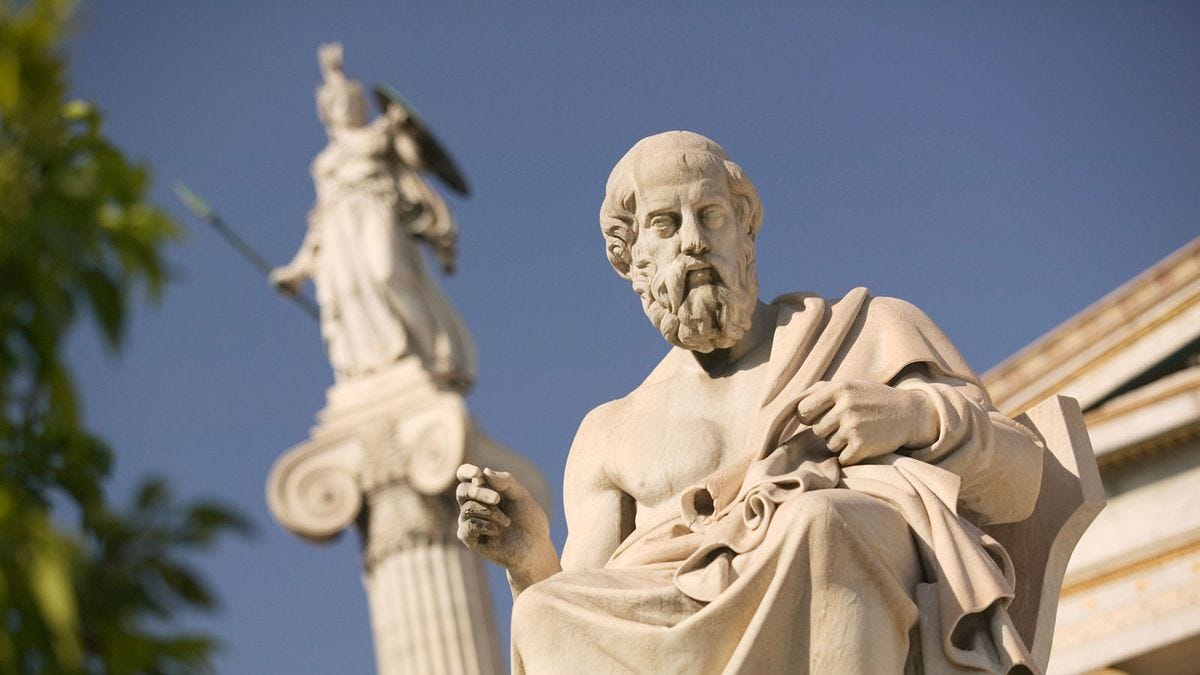
As the story goes, above the doorway to Plato’s academy was written, “Let no one ignorant of geometry enter here.”
Which is unfortunate because I quite like Plato and I am rather poor at math (read: 60 percentile point gap between my verbal and math GRE scores). To further complicate the matter, I’ve recently signed up to spend a semester studying Euclid. Prayers appreciated.
My personal woes with mathematics, however, made me feel rather vindicated when I came across a curious passage in Arthur' Schopenhauer’s, The World as Will and Representation, where he states that the genius hates mathematics.
Now, hating mathematics doesn’t automatically make one a genius, but hey, maybe I’m halfway there?
In this week’s essay, we’re going to unpack what Schopenhauer meant, how it illuminates his entire system, and whether, in the end, math is morally problematic. Please note, the tone and style will be a bit different as this is an adaptation of a paper I wrote for my master’s program at St. John’s College.
Enjoy.
In Arthur Schopenhauer’s The World as Will and Representation, he describes the genius as the rare man in the midst of the world who has “the capacity to remain in a state of pure perception, to lose oneself in perception, to remove from the service of the will the knowledge which originally existed only for this service.” This capacity propels the genius to intellectual, artistic, and moral heights.
Within this framework, one aspect of the genius stands out as particularly interesting: the genius dislikes mathematics. Though this could appear to be nothing more than a passing quip, another discipline receiving the sharp end of Schopenhauer’s penchant for verbal barbs, upon further reflection, it can be seen as a key to his view of the world. In this essay, I intend to explore why it is that the genius dislikes math and what this reveals to us about Schopenhauer’s overall project.
That the Genius Dislikes Mathematics
Though mathematics appears early in Schopenhauer’s work, it isn’t until Book III that he directly distinguishes between men of genius and men of mathematics. There he writes, “The disinclination of men of genius to direct their attention to the content of the principle of sufficient reason will show itself first in regard to the ground of being, as a disinclination for mathematics” (189). This is both a logical outcome of his system as well as a truth readily discerned through experience. On the latter, Schopenhauer writes, “Experience has also confirmed that men of great artistic genius have no aptitude for mathematics; no man was ever very distinguished in both at the same time” (189). He goes on to demonstrate that great geniuses like Alfieri and Goethe were notoriously bad at math. Instead of this calling into question their genius, it serves as a positive indicator that genius and mathematical ability are negatively correlated.
Where Math Goes Wrong
For Schopenhauer, Euclid set mathematics off on a problematic trajectory that continued apace for two-thousand years. Euclid’s primary mistake was to replace the immediate knowledge of perception or a priori intuition with the mediated knowledge of concepts and logical deduction. Schopenhauer writes, “Mathematics, on the contrary, is at great pain deliberately to reject the evidence of perception peculiar to it and everywhere at hand, in order to substitute for it logical evidence. We must look upon this as being like a man who cuts off his legs in order to walk on crutches” (69). This rejection of perception in favor of logical evidence means moving away from the ground of being to the ground of knowledge. In other words, it’s a movement away from why a thing is to what a thing is. And, to be more specific, it’s a movement toward reflecting on our own knowledge about what a thing is in terms of abstract propositions, rather than understanding the essence of a thing intuitively.
To elucidate this distinction, Schopenhauer offers the example of a triangle. He writes:
[Euclid] ought to show once for all how in the triangle angles and sides reciprocally determine one another, and are the reason or ground and consequent of each other … Instead of thus giving us a thorough insight into the nature of the triangle, he posits a few disconnected, arbitrarily chosen propositions about the triangle and gives a logical ground of knowledge of them through a laborious logical proof (70).
If mathematics were to follow intuition, as Schopenhauer desires it to, it would provide a knowledge that is more certain because intuition reaches to the why of a thing, to the ground of being. However, since mathematics has become preoccupied with proofs, it merely shows how propositions are related to one another.
Proofs belong to abstract reflection, but, as Schopenhauer notes, “the whole world of reflection rests on the world of perception as its ground of knowledge” (41). In other words, syllogisms and logical chains of reasoning cannot get off the ground without a prior perception. Now, figures like Euclid might grant that perception is the starting point, but they proceed to proofs because these appear more reliable. This too is a mistake.
While senses can be deceived, this is not true of the a priori perception that is involved in mathematics. “[Euclid’s] method remained the prevailing one throughout all the centuries and was bound to remain, so long as there was no distinction between pure intuition or perception a priori and empirical perception,” explains Schopenhauer (71). In other words, we already know intuitively what Euclid labors to demonstrate empirically. This is a “useless precaution,” in Schopenhauer’s mind and is the reason he described Euclidean geometry as crutches for healthy legs (71). In the case of geometry, a mathematician only needs to perceive a priori the nature of space relations, and in the case of arithmetic, the mathematician perceives a priori time relations. In both cases, these are not conceptual reflections but intuitions that can be analyzed as a process of thought grounded in intuition.
All of this leads to Schopenhauer’s proposed remedy for mathematics in a post-Euclid world:
To improve the method of mathematics, it is specially necessary to give up the prejudice that demonstrated truth has any advantage over truth known through perception or intuition, or that logical truth, resting on the principle of contradiction, has any advantage over metaphysical truth, which is immediately evident, and to which also belongs the pure intuition of space (73).
With a firmly intuitive mathematics, the discipline can carry on unhindered by the faulty epistemology that has burdened it with abstractions when perception is the most natural way of doing mathematics.
Forms of Knowledge and the Knowledge Unique to Genius
From the perspective of the average subject, the world is representation. This is to say that the average man does not know the world as things-in-themselves, but rather as a mental representation derived from sense data but not equivalent to it. In Schopenhauer’s words, “What the eye, the ear, or the hand experiences is not perception; it is mere data. Only by the passing of the understanding from the effect to the cause does the world stand out as perception” (12). In this way, the world exists only so long as there is a rational creature capable of representing it to the mind. As Schopenhauer vividly describes it, “the existence of this whole world remains for ever dependent on that first eye that opened … The world is entirely representation, and as such requires the knowing subject as the supporter of its existence” (30). Within this world of representation, all knowledge follows the principle of sufficient reason which is governed by the laws of space, time, and causality.
In the realm of the principle of sufficient reason, we can further distinguish between two ways of knowing. First, the subject can know through intuition or perception. As we saw, this is Schopenhauer’s preference for how mathematics should proceed, and indeed, it is the more certain of the two ways of knowing as it reaches to the ground of being. Second, the subject can through reason by making use of abstract concepts and logical deductions. This way of knowing relates to the ground of knowing as it creates knowledge that has reference to propositions rather than intuitions.
For the great mass of men, these are the options that are available as they live their lives under the shadow of the principle of sufficient reason and are firmly entrenched in the world as representation. There is, however, another side to the world. From the side of the object, the world is will. In something akin to the Kantian noumenal-phenomenal divide, Schopenhauer offers the world as will and representation, in which the will relates to the thing in itself which is inaccessible to man through the principle of sufficient reason. However, Schopenhauer offers a way to bridge the chasm between the subject and object, between representation and will: contemplation.
This contemplation is the state of “pure perception” not in service to the will that we noted at the beginning is the fundamental to the nature of the genius. In contemplation, the genius becomes one with the object in such a way that he no longer knows the particular thing he’s contemplating, which, as a particular, would be subject to the principle of sufficient reason, but reaches beyond the particular to the Platonic Idea. Schopenhauer writes, “The individual as such, knows only particular things; the pure subject of knowledge knows only Ideas” (179). He goes on to say, “The pure subject of knowledge and its correlative, the Idea, have passed out of all these forms of the principle of sufficient reason. Time, place, the individual that knows, and the individual that is known, have no meaning for them” (179). What makes this form of knowing possible is that, at an ontological level, all things are truly one will.
In the world of space, time, and causality, we see through the veil of maya and the principium individuationis which delude us into thinking we are separate, but the genius breaks free from this and recognizes the unity of all things. This unity allows the genius to become one with the object not because of a change in the ordering of reality, but rather, as the subject, he disavows himself of the lie of individuation and gives himself over to the unity that has been there all along. As Schopenhauer explains, “the transition that is possible but to be regarded only as an exception, from the common knowledge of particular things to knowledge of the Idea that takes place suddenly, since knowledge tears itself free from the service of the will precisely by the subject’s ceasing to be merely individual, and being now a pure will-less subject of knowledge” (178).
If such a form of knowledge disinclines one to mathematics, which is caught up in the principle of sufficient reason as it regards space and time relations in geometry and arithmetic respectively, it inclines one to art. Not only does this knowledge allow someone to produce great art, but Schopenhauer even seems to suggest that such a form of knowledge is itself art. He writes, “We can therefore define it accurately as the way of considering things independently of the principle of sufficient reason, in contrast to the way of considering them which proceeds in exact accordance with this principle, and is the way of science and experience” (185). Nevertheless, this way of considering things does seem to lead to production of great art. After describing art as the work of genius, he writes, “[Art] repeats the eternal Ideas apprehended through pure contemplation, the essential and abiding element in all the phenomena of the world” (184).
The viewer of the art then benefits from seeing through the eyes of the genius to glimpse at the Ideas. The fact that men can appreciate art means that there is some trace of genius in them. Thus, genius is not necessarily a strict dichotomy but something more akin to a sliding scale. The man defined by genius is able to maintain a state of pure perception for extended periods of time, while a man with only traces of genius is able to momentarily see the Ideas through a genius’ work of art.
Could there be a mathematical genius?
Schopenhauer’s treatment of genius focuses positively on two areas: art and morals. The former we’ve seen above, and the latter is primarily consigned to Book IV in which he discusses the genius’ ability to see the oneness of all people, treat them all as himself, and, through ascetic rigor, detach himself from the will to reach the heights of ethical purity. More will be said on the latter in due course, but for now, we must ask a question that Schopenhauer does not directly address: Could there be a mathematical genius?
The question may appear odd on the surface, considering the fact that Schopenhauer asserts that the genius is disinclined to mathematics. However, we’ve already seen that Schopenhauer can speak of different modes of mathematics, with some better than others. It appears clear that Schopenhauer would not consider Euclidean geometry a domain of genius as it relies upon abstract, rational knowledge and as such pertains only to the ground of knowledge rather than the ground of being. Schopenhauer’s version of geometry, however, relies on perception, which is the domain of genius. He even refers to geometrical propositions as “metaphysical truth” which can be known intuitively through pure perception of space relations (74). So too with arithmetic, Schopenhauer says, “counting is nothing but intuition or perception a priori, to which we do not hesitate to refer, and by which alone every calculation, every equation is ultimately verified” (75).
With a perceptive form of mathematics in view, do we not have all that is needed to hail the practitioner of this discipline a genius? For Schopenhauer, the answer remains firmly negative. The reason for this is that geometry, even powered by perception, is still a reflection on space relations and therefore belongs to the world of representation governed by the principle of sufficient reason. Likewise, arithmetic, even done perceptively, is still a reflection on time relations, and therefore, once again, it operates under the shadow of the principle of sufficient reason. Furthermore, while Schopenhauer believes that counting is, at its most basic level, perceptive, it cannot remain so for long. As he writes, “our immediate perception of numbers in time does not extend to more than about ten” (75). After this, a pure perception of numbers is replaced by abstract concepts.
The Genius’ Disinclination for Math as a Key to Schopenhauer
From what has already been said, it should be clear that the genius dislikes math because math is confined to the world of representation which is known through the principle of sufficient reason and governed by the laws of space, time, and causality. This world of representation keeps the subject from true knowledge of the object as thing-in-itself and maintains the lie that the subject is a true individual rather than one with all things. Though mathematics can be done in better and worse ways, even at its best, it remains a discipline tied to the principle of sufficient reason.
The genius, however, strives for more. The genius wants to move beyond the principle of sufficient reason to the thing-in-itself, and he can do that through contemplation and express that in art. Like the intuitive mathematician, the genius has no need for concepts to have true knowledge. Unlike the mathematician, the genius is freed from the principle of sufficient reason.
The genius’ disinclination for mathematics allows the student of Schopenhauer to distinctly grasp Schopenhauer’s epistemology which is grounded in his metaphysics. This we have noted above in the division between types of knowledge arising from the two-sided nature of the world as will and representation. Due to the unity of Schopenhauer’s work, the genius’ disinclination for mathematics also sheds light on Schopenhauer’s ethics.
We’ve already seen that the genius has the unique ability to detach himself from the will. Thus far, we’ve considered this in relation to his form of knowledge. However, as Schopenhauer develops in Book IV, it also has ramifications for ethics. When the genius dissolves the principium individuationis by recognizing his metaphysical unity with all things, he soon discovers an important truth: to harm another is to harm himself. As Schopenhauer insists, “Tormentor and tormented are one” (354). Just as the aesthetic genius is marked by a changed form of knowledge, in contradistinction to the mathematician, so too is the moral genius one who moves beyond the principle of sufficient reason. As Schopenhauer writes:
But when the principium individuationis is seen through, when the Ideas, and indeed the inner nature of the thing-in-itself, are immediately recognized as the same will in all, and the result of this knowledge is a universal quieter of willing, then the individual motives become ineffective, because the kind of knowledge that corresponds to them is obscured and pushed into the background by knowledge of quite a different kind (403).
Here, when Schopenhauer speaks of the knowledge corresponding to motives, he is speaking of knowledge governed by the principle of sufficient reason. That knowledge relies on cause and effect, and, in the same way, man’s actions rely on and are determined by motives. The genius, however, can know things apart from the principle of sufficient reason, moving beyond cause and effect, and this in turn allows him to act in ways that are not governed by motives. Just as contemplation leads to knowledge of things-in-themselves, so too does it lead to freedom in man because he moves beyond motives, which correspond to phenomena, and is able to see himself as will. When man sees himself as will, he is no longer slave to this will because he has broken free from the way in which the will determines actions: motives. To understand this we must recognize that “real freedom … belongs to the will as thing-in-itself” (402). To move beyond the world of representation to the world of will is then a movement away from necessity and into freedom.
Summary
Therefore, we could summarize our findings as follows. The genius is disinclined to mathematics because math operates under the laws of the principle of sufficient reason, which govern the world as representation, while the genius, as one who can transcend the world of representation via pure perception, desires to grasp more clearly the world as will, as known to him in the Ideas, apart from the principle of sufficient reason. This form of knowing constitutes art and produces it. Furthermore, in crossing over to the world as will, the genius recognizes the oneness of the will, and thus the oneness of all things. This oneness forms the basis of his morality. Seeing the world for what it is, he strives not only to do no harm to others, which would be harming himself, but he attempts to detach himself from the will through asceticism, recognizing that the will is the universal cause of suffering in man. Art, then, could be construed as a moral good as it leads men away from the veil of maya and toward the Ideas, and this movement is the basic ascent of the genius which culminates in his freedom. Math, on the other hand, keeps men firmly planted in the world as representation, living as slaves to the will, and suffering as a result.
Schopenhauer gets a sad/10 from me. Very interesting stuff, but his distaste for math displays both a misunderstanding of mathematics (in my view) and a clear underlying...unreasonable judgment of mathematics lol.
I suppose where I think he really goes wrong is in thinking of the axiomatization of math as enforcing the PSR? You can only have correct intuition about mathematical objects after spending a ton of hours learning about all of the weird nonsense that can happen. It can't just be "well this feels right so it is", which seems to be what Schopenhauer argues for. I've put together a list at the bottom of YouTube videos which should be accessible to most anyone that display some deeply *unintuitive but true* facts about math. The last two in particular are geometric in nature, so Schopenhauer doesn't have any excuses for those objects being "wholly the realm of the PSR" or whatever.
https://www.youtube.com/watch?v=uvMGZb0Suyc
https://www.youtube.com/watch?v=n7GYYerlQWs
https://www.youtube.com/watch?v=wKV0GYvR2X8
Sorry Schopenhauer, the representation of you I intuit is of a madman raving