
Was this Encyclical Really about AI?
Joining the Chorus of Commentary on Magnifica Humanitas

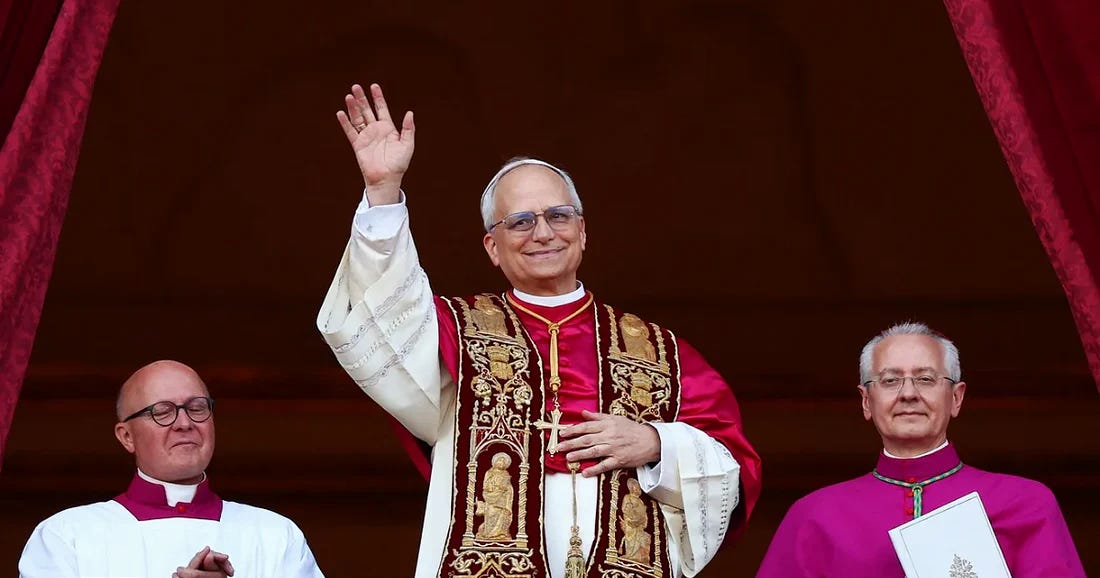
If you’re more of a video person, this essay formed the basis of a video I recorded on Magnifica Humanitas. Usually, I keep YouTube and Substack separate, but the pope dropping an encyclical on AI is something of a special occasion. You can watch that here.
I’m an Anglican (Episcopalian if we’re being specific), but like many of you, when I found out Pope Leo was writing an encyclical on AI, I couldn’t wait. From day one of his pontificate when he took the name Leo XIV, he signaled that Catholic Social Teaching would be a major focus of his, building on the legacy of Pope Leo XIII who published the foundational work of Catholic Social Teaching, Rerum Novarum in 1891. What was implicit in the pope’s choice of that name has been made explicit in Magnifica Humanitas. On the surface, this is an encyclical about AI, but it goes much deeper than that. Pope Leo has taken the opportunity presented to him by cultural interest in AI to introduce the world to Catholic Social Teaching.
I, for one, think that’s great.
I’ve said in the past that it mystifies me that Catholic apologists don’t spend more time talking about Catholic Social Teaching. Sure, the New Eliakim argument for the papacy is cool, but Gaudium et Spes? Now we’re talking. Pitching Catholicism without talking about Catholic Social Teaching is like telling people they should check out San Diego and not mentioning the beaches or the fact that it’s sunny and 75 everyday. Anyway, Pope Leo seems to agree. In fact, to help the cause, he spent the first 89 paragraphs explaining the history and theology behind Catholic Social Teaching.
Now, if you were just looking for his thoughts on AI, this can feel like quite a lot of throat clearing before getting to the point, and I’ve seen a lot of people complaining that the document is longer than it needs to be. Such a view isn’t without merit, but I think it misses what the pope is trying to do. AI is merely the occasion for the encyclical. AI forces us to ask questions about human dignity and the common good, and I get the sense that it’s those things, the central aspects of Catholic Social Teaching, that Pope Leo wanted to talk about more so than just AI.
And when you pause to think about this, it makes sense, right? The pope isn’t an expert on large language models or machine learning. And as he insists in the document, if he focused on the technology itself, the encyclical would be obsolete as soon as it hit the press because the technology is developing so quickly. The fundamental principles of Catholic Social Teaching, however, have a much longer shelf life because they’re rooted in the unchanging truths of the gospel.
In this article, I want to briefly unpack the main theme of the document before exploring some of the fascinating and unexpected areas that the Pope also covered in this landmark encyclical.
The Main Idea
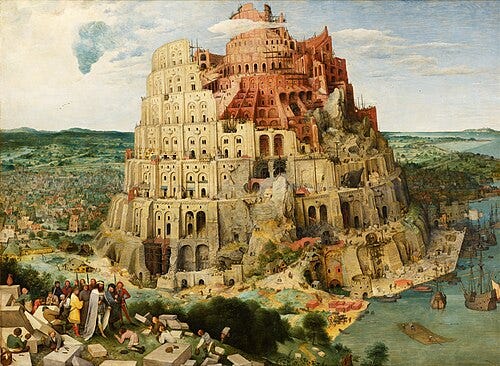
In terms of how we ought to approach AI, Pope Leo’s writing shows his Augustinian roots. He places us at a fork in the road: will we build a new Babel or a New Jerusalem? This is the guiding metaphor throughout the encyclical, and it echoes St. Augustine’s notion of two cities in his magnum opus, The City of God.
It’s important to realize that this isn’t a choice between loving or hating technology. If you’re thinking of a fork in the road between embracing AI or swearing an oath to never touch it, you’re missing the mark. The difference is more subtle. Here’s how Pope Leo puts it, “Therefore, the primary choice is not between a “yes” or “no” to technology, but rather between constructing Babel or rebuilding Jerusalem; between a power that claims to dominate the heavens and a people who work together in the presence of God to rebuild the walls of fraternal coexistence” (9).
Throughout the document, building Babel represents modes of engaging with technology that arise from a desire to transcend the limits of humanity, degrade human dignity, usurp the place of God, and benefit the strong at the expense of the weak.
In contrast, rebuilding Jerusalem is a collaborative effort done for the common good in alignment with the truths of human nature as it is in relationship to God.
That might all sound a bit abstract. And some of that is the point. This isn’t a policy brief on AI. It’s an attempt to apply the principles of Catholic Social Teaching to AI generally. This can be seen clearly in paragraph 109, where Pope Leo offers a condensed picture of how this works. It’s worth quoting at length here. He says:
To speak of the universal destination of goods means finding ways of ensuring universal access to both technologies and the education needed to use them. To speak of subsidiarity calls for protecting the ability of communities to make choices and corrections, rather than confining their role to mere oversight after the standards have been set elsewhere. To speak of solidarity obliges us to recognize the hidden, often exploited workers, who sustain algorithmic systems. To speak of justice requires questioning the global distribution of power that decides who in fact can train these models and who is merely subjected to them. Likewise, it means acknowledging that social justice is not only a goal to be safeguarded after technologies are deployed, but a condition that must shape their very design from the outset.
If you came into this looking for advice on whether to use Claude, ChatGPT, or none of them, you’ll be disappointed. That’s not what’s offered. Nor does Pope Leo give explicit instructions around what kind of tasks AI can and can’t be used for. Instead, he asks higher level questions, and the fundamental one is expressed in paragraph 129, where he states, “Ultimately, the key question remains the one posed by Saint John Paul II: does AI “make human life on earth ‘more human’ in every aspect of that life? Does it make it more worthy of man?” This is the ultimate question because at its core, Catholic Social Teaching is about safeguarding human dignity, which in turn is grounded in the fact that humans are made in the image of God. So, does AI make us more or less truly human?
Answering that question takes wisdom and discernment, which can be aided by the rich principles found in Catholic Social Teaching. Principles like the universal destination of goods, subsidiarity, solidarity, and social justice. Even with them, though, difficult questions remain. And in such cases, prudence calls for patience. Perhaps one of the more underappreciated yet vitally important parts of this document is a call to move slowly. To not get caught up in the zeitgeist. To that end, Pope Leo calls for “slowing things down when everything is accelerating, and of protecting the opportunities for communities still to be able to participate and ask questions” (107).
Rebuilding Jerusalem is a slower, more arduous task than constructing a new Babel, but shortcuts here are destined to meet the same end as Babel. In a time of rapid change, the Christian is called not to knee-jerk rejection or uncritical acceptance, but to wise and patient discernment guided by the light of revelation and the resources of our tradition.
The Side Quests
Alright, so that’s the main gist of Magnifica Humanitas, but to change gears a bit, I want to touch on some surprising but fascinating parts of the document that you might not hear as many people talking about because, as I said, this encyclical is about so much more than AI.
Women’s Rights
First on my list of surprising inclusions are a few gems about the importance of women’s rights. In a time of reactive takes on gender relations within more traditionalist Christian spaces, I really enjoyed reading Pope Leo’s strong affirmations of women’s rights. Here’s how he put it: “It is, therefore, not enough to state simply that men and women have equal dignity and rights; it is necessary that this be reflected in concrete decisions, such as in laws, access to employment, education, social and political responsibilities, and the way society listens to and values women’s contributions. As long as this gap persists, we cannot say that society truly and fully recognizes that women have the same dignity as men” (57). For more on this topic, I suggest checking out this article by Claire the Catholic Feminist.
Disarmament
Next up we have the idea of disarmament. Pope Leo describes the phrase “to disarm” as close to his heart (110), and he sees this connecting to everything from war to mental health to the environment. In essence, we need to create technology that is peaceful in the full sense of that word. By the end of the encyclical though, he moves disarmament away from discussion of AI to focus on modern geopolitics. He warns against a rising support of realpolitik in which might makes right and wars are fought not for justice but for selfish pursuits. Given his criticisms of the war in Iran and war generally, this was par for the course in many ways, but I wasn’t expecting it in an encyclical about AI. Nevertheless, I’m totally here for it.
Slavery and Doctrinal Development
The next one is for my doctrine nerds. Given what we’ve seen so far in how the encyclical touches on a range of topics related to Catholic Social Teaching, the fact that Pope Leo talks about slavery in Magnifica Humanitas shouldn’t be that surprising. However, two things in his discussion of slavery were surprising. First, there’s the fact that he apologized for the Catholic Church’s role in legitimizing slavery. He says the fact that it took the church 18 centuries to recognize the full incompatibility of slavery with the Church’s commitment to human dignity is a wound in the Christian memory and sincerely asks for pardon in the name of the Church. This isn’t the first papal apology, but they are still a relatively new phenomenon which we didn’t see much before the pontificate of Pope John Paul II. It’s a trend I deeply respect, and while not contradicting papal infallibility, papal apologies do guard against thinking the church or the pope can do no wrong.
That’s not the only interesting thing about the document’s discussion of slavery though from a doctrinal perspective. Something that really jumped out to me was the way in which the church’s relationship with slavery is marked out as a clear example of how the church’s growth in understanding–what’s broadly called doctrinal development–works. Here’s how Pope Leo puts it: “This development offers a clear example of the Church’s growth in understanding the perennial truths of Revelation that she safeguards. Although there was not always consistency in practice — given that slavery was long tolerated before being unequivocally condemned — there has been a continuous affirmation throughout history of the dignity of every human being, created in the image of God, even if it took eighteen centuries for its full incompatibility with slavery to be explicitly recognized (176).” Now, this is quite remarkable as it paints a picture of doctrinal development that is quite malleable. The basic idea is that development is occurring within a context of both continuity and discontinuity. The continuity is the Church’s affirmation of human dignity. However, there is discontinuity between legitimizing slavery and then classing it as something intrinsically evil, as Pope John Paul II did and popes since him have done. This means that doctrinal development can involve long precedents in the opposite direction as long as there’s a more fundamental continuity. Something similar happens with the church’s teaching on religious liberty. Examples like these suggest that Catholic practice–and I would argue, non-infallible teaching as well–is more subject to change than people might think.
Francis and Synodality
The final thing I want to highlight in this document is admittedly a bit less of a surprise but nevertheless still interesting. That is the document’s reaffirmation of synodality as vital to the church’s life. This reflects a broader trend of Pope Leo carrying the torch for some of Pope Francis’s trademark projects. Pope Leo goes as far to say that, “In the ecclesial context, the common good takes the form of a synodal approach for mission at the service of the Kingdom” (86). In total, Pope Francis is referenced more than 50 times in the document. Pope Francis was a figure that divided opinion, and one of the central questions when Pope Leo was elected was whether he would continue in his predecessor’s footsteps or not. Judging from this encyclical, the answer to that question seems to decisively be “yes.” That is not to say he’s a carbon copy. In terms of personality, they’re pretty different figures. In time, Pope Leo may reveal more areas where he disagrees with Pope Francis. But for now, he seems to be continuing his project and walking in line with his vision for a synodal church. And to me, that’s quite good news.
Odds and Ends

Exciting news! I’ll be leading a pilgrimage along the Camino de Santiago July 8-18, 2027. We’ll be doing a shortened, easier version of the walk with luggage carried and transportation shuttling us between some of the most scenic stretches. But don’t worry, there will still be plenty of walking involved. Learn more: here.
In case you weren’t aware, my novel, The Long Road to Holy Island, is now available for pre-order. It’s a story about a grieving young man who embarks on the pilgrimage his mother always dreamed of—St. Cuthbert’s Way—despite not sharing her faith. Along the way, he meets a monk who becomes his traveling companion, and through their conversations and other people he meets, the protagonist is forced to wrestle with questions of faith in a world that so rarely makes sense. Pre-ordering is a huge help, especially for debut authors like me. So, if you’re so inclined, it would mean a lot to me if you grabbed a copy early.
If you’re looking for ways to start studying church history, I recently put together a Church History in a Year reading guide which takes you through 2,000 years of primary sources in just 52 weeks. It’s available for $15 individually or freely to all my Patrons.
Finally, paid subscribers receive access to my book club, in which we’ll be reading C.S. Lewis’s masterpiece, Till We Have Faces over the summer. We’ll meet June 22, July 20, and August 17 at 8pm EST on Zoom. Recordings are provided for those that can’t make it.
Thanks for this Austin. Due to a number of family and work matters I haven’t yet read the encyclical and I greatly appreciated your summary. I will be reading a couple Pillar contributions before I can free up to read the encyclical itself .
Thank you for this helpful analysis.
I’m curious: Do you think AI in itself is honouring to imago dei, given that it is a robotic amalgamation? ie, are there some technologies that are just intrinsically dishonouring?
Also, do you use AI in your writing?