
Weep for Your Sins?
A Tightrope in the Spiritual Life

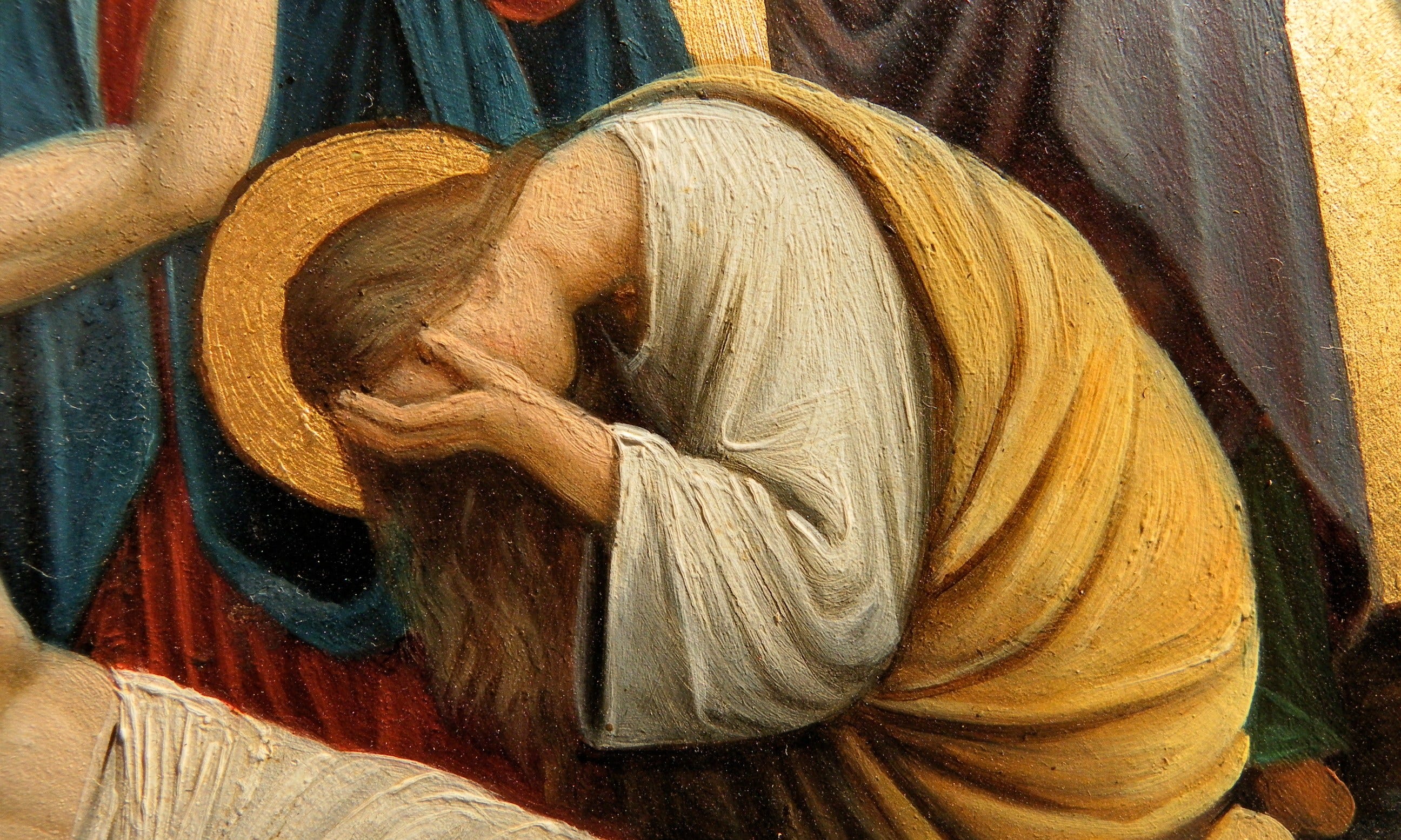
If you read the Desert Fathers, and you most certainly should, you will come across one theme again and again: weeping. You can find this in the most prominent figures like Anthony, Macarius, and Moses as well as in more obscure figures. Abba Poemen, whose sayings comprise about one-seventh of the Alphabetical Collection, offers a clear picture of the Desert Fathers’ teaching on weeping for your sins:
A brother asked Abba Poemen what he should do about his sins. The old man said to him, ‘He who wishes to purify his faults purifies them with tears and he who wishes to acquire virtues acquires them with tears; for weeping is the way the Scriptures and our Fathers give us, when they say ‘Weep!’ Truly, there is no other way than this.
In many similar sayings, we find the Desert Fathers telling people, “If you can become a monk, great. But if not, sit in your cell and weep for your sins and you’ll accomplish the same.”
The idea of weeping as central to the Christian life neither began nor ended with the Desert Fathers. As Abba Poemen alludes to, the Scriptures are replete with weeping, and as time went on, “Holy Tears” took on a prominent role in the Christian imagination.1 As with so many other things, the Medieval West systematized this practice. Prayers for tears were included in votive masses, instructions for crying were written by scholastic theologians, and St. Catherine of Siena offered a typology of tears in her Dialogue.
It was during my undergraduate years that I first came across this strand of the Christian tradition. I was writing two undergraduate senior theses on St. Catherine (one for History, one for Theology) so I was immersed in Catherine’s effusive language about holy tears. Simultaneously, I was enamored by the Church Fathers, intrigued by the East, and like so many people who start exploring Orthodoxy, I had my copies of the Desert Fathers and The Way of a Pilgrim always close at hand—and said hand quite naturally had a chotki on its wrist. This combination of influences meant I couldn’t ignore a theology of tears.
In some ways, it was quite amenable to my emotion-centric Evangelical upbringing. Seeing people cry during worship nights or on youth retreats was common, and indeed, expected. If students weren’t crying by the end of the Saturday night session of a weekend retreat, we would’ve thought something was wrong. I myself wasn’t immune from that.
And yet, as I soon found, there’s something rather different about crying while the band sings the bridge for the 15th time on a sleep-deprived weekend versus sitting in your dorm room—as close as I’ve ever been to a cell—on a Tuesday night and trying to weep for your sins. I can remember several occasions in which I sat by myself and did all I could to think of my sins and weep. And … nothing.
Turns out, that’s easier said than done.
As someone with a perfectionist streak in me, this was both annoying and dangerous. Annoying, in that I wasn’t fond of being bad at this seemingly basic Christian task. Dangerous, in that such attempts for weeping over one’s sins can turn to a spiritually harmful self-castigation if one is not careful. When we try to manufacture tears for our sins, it’s quite easy to shift our focus away from the sins themselves and toward ourselves. What seems a subtle difference on the surface can be disastrous in its consequences.
That difference—one we often neglect—is what I want to focus on today.
Self-Pity and Self-Hatred is Bad Theology
During my undergrad years, I wasn’t just reading Catherine and the Desert Fathers. As I was at an evangelical bible college, I was surrounded by more than a fair share of young, restless, and reformed types, the precursors to the current, young, rooted, and apostolic types. On several occasions, I recall my hyper-reformed peers asking questions like, “how can we teach children in Sunday school that they are sinners by nature and deserve God’s wrath?” The “how” in that sentence wasn’t a how of moral indignation (i.e., “how could you?!”) but a how of practicality, of necessity.
Having gorged themselves on John Calvin (or, more likely, popularizers of Calvin), they felt a deep need to convince people, including children, that they were really, really bad.
With ideas like this in the air, the tradition of Holy Tears can be cannon fodder for showing people that one of Christianity’s primary tasks is convincing people they’re abominable. And to be fair to these cage-stage Calvinists, it’s not as though such teaching is entirely absent from the tradition prior to Calvin. The line between weeping for sins and weeping for your depravity is, as I said, a narrow one.
However, when we make Christianity out to be a message of your general awfulness, we distort the Gospel and disrupt Christian formation. It is not that we should not believe we are sinners. Indeed, with St. Paul we should be able to say, “Of sinners, I am the worst.” Though I’m not personally a fan of, “the Gospel isn’t good news if you don’t include the bad news first,” it is nevertheless the case that if we remove any seriousness about sin from the Gospel then the Gospel becomes unrecognizable.
We must remember that when God created us in His image, and that when He surveyed all of creation, He deemed it very good. Though sin entered the world as a profound sickness, in Christ God is—and in another sense, has already—redeeming and restoring all things, making us a new creation. Much of the best Patristic theology only makes sense once we recognize that the message of the Gospel is not, “you suck, hate yourself, and maybe if you convince yourself of that enough, God will be better disposed toward you.” Instead, it’s more like, “your soul, having been made by God is naturally good—it could be no other—but the sickness of sin has caused your desires to become disordered, encumbered by passions. Christ offers healing, and this involves liberation from the passions so that your soul can do what it most naturally desires, seek God.”
Of course, in fairness to Christians of all stripes, I don’t think the “you suck message” is a good representation of any theological system at its best. But to a 20-year old in his college dorm room reading the Desert Fathers and St. Catherine, it’s easy to take “weep for your sins” in that direction. And when the tears don’t come, it only serves as further indication that you are, in fact, the worst. This is a flawed theological anthropology leading to poor spiritual formation.
A better path—one that can make room for Holy Tears, properly understood—is to recognize another important insight from the Tradition: nothing is worth losing your peace.
Even our own sinfulness should not be something that causes us to forsake peace in favor of despair. As Abba Dorotheos writes, “Allowing ourselves to be disturbed by these experiences is sheer ignorance and pride because we are not recognizing our own condition and are running away from labour.”2 Whatever it means to weep for our sins, it does not mean becoming greatly agitated or surprised on their account.
Fr. Jacques Philippe in his wonderful little book, Searching for and Maintaining Peace, argues that much of the time, our self-castigation is a not-so-subtle form of pride. Here’s how he puts it:
The sadness and the discouragement that we feel regarding our failures and our faults are rarely pure; they are not very often the simple pain of having offended God. They are in good part mixed with pride. We are not sad and discouraged so much because God was offended, but because the ideal image that we have of ourselves has been brutally shaken. Our pain is very often that of wounded pride! This excessive pain is actually a sign that we have put our trust in ourselves — in our own strength and not in God.3
Often, we set unrealistic standards for ourselves as a way of trying to buy into a false image of our own perfection, and then we reprimand ourselves for not meeting them. Not only does this evince an elevated view of self, but it also is a defense mechanism against holding ourselves to reasonable standards. We don’t want to accept where we are, so we protect ourselves—paradoxically—by pretending we ought to be perfect because failing to be perfect is an easier pill to swallow than failing to be decent.
What we need to recognize, indeed what we need sufficient faith to accept, is that God loves us exactly where we are, not where we pretend to be.
This isn’t to make light of sin. Sin is truly the sickness that is ravaging the world. The Fathers were right that we should weep for our sins, but we must not weep for ourselves. We must not have so little faith in God’s goodness toward us nor in the fundamentally good nature of the souls He created that we should despair of ourselves.
There is a tightrope to be walked here. On the one hand, we have the temptation to think we’re so great on our own that we could do no wrong. We’re just misunderstood. It’s the world’s fault, etc. On the other hand, we are tempted to think our sins are so great that it must mean that we—even as we are before Christ, which is our true self—are despicable. We’re awful. We can never do anything right. We’re unworthy of love, etc.
The paradox of formation is that these often exist side-by-side. Not believing we’re lovable on our own, we create an image of ourselves that is inflated, desperately praying that version of us will finally be enough. Perhaps we deflect blame entirely. Or, perhaps we castigate ourselves. Either way, we end up pretending we’re someone we’re not.
Believe you’re unlovable, awful? A lie.
Believe you’re perfect but misunderstood? A lie.
Believe you’re truly perfect on your own (i.e., not by grace) but constantly failing at that? A lie.
The truth? You are loved infinitely by God. You also screw up. A lot. And those sins are probably certainly more destructive than you realize. That which you hate in the world is probably connected to that which you do.
And yet, you are good, not because of what you do but because you are created by God.4 You are loved. A mess? Most certainly. In deep need of healing? Without doubt.
The key connection between the teaching of the Fathers and Philippe is honesty and awareness. We must cultivate an honest awareness of ourselves before God, recognizing simultaneously the goodness of our creation, the infinite love of God, and also our utter dependence upon God’s grace. Fundamentally, who we are is who we are before God, not apart from Him, for there is no being who is truly apart from God, who is Being itself.
Returning to St. Catherine, she argues that self-awareness is the beginning and end of the spiritual life. But it’s not just any awareness. True self-awareness, or what she calls “seasoned” self-awareness, is seeing simultaneously two things: our own sins and the image of God in us. Noticing the dissonance between those things in our souls is the beginning of the spiritual ascent and also something we never grow beyond.
At some point, the Holy Tears may come. We may gain insight into the full depth of the tragedy and horror of sin. But in my own experience, I would merely caution that trying to jump straight into weeping in your cell without first having a proper view of the self can be disastrous. We must have that seasoned self-awareness, that abiding sense of God’s grace and love if we are to not turn attempts at weeping into an exercise in a self-hatred that only reinforces a false vision of the self that keeps us from true growth. And if St. Catherine is right, those tears ought to move quickly from tears of despair to tears of joy, tasting and seeing that the Lord is good.
For more, see: Holy Tears: Weeping in Religious Imagination, ed. Kimberley Patton and John Hawley.
Qtd in, Metropolitan of Nafpaktos Hierotheos, Orthodox Psychotherapy, 265.
Philippe, Rev. Jacques, Searching for and Maintaining Peace, 61.
I hate putting a footnote on this, but alas, for the theology police: I am not denying that we are in need of salvation. I am not denying the reality of sin or the fall. What I am denying is that the fall so radically changed our nature such that our souls are, in and of themselves, evil. You are because God is. God is Goodness itself. Evil is a privation. Your soul is not composed of evil or a mix of good and evil. It is good, yet profoundly sick. And the good news is Jesus came for the sick.
love this. also I listened to this while driving and found it especially amusing that the AI narrator decided to pronounce "st Catherine" as *street Catherine"
Austin… this is potent stuff. What clear and needed distinction.